Client Segmentation and Private Banking: Marketing Strategy or Risk Shield?

Mathis HOUROU

In this article, Mathis HOUROU (ESSEC Business School, Global Bachelor in Business Administration (GBBA) 2022-2026) explains why Private Banking’s client segmentation is not just about sales, but also a crucial risk management tool for banks.

Introduction

In business school, we learn that client segmentation is a commercial tool. In Private Banking, it is used to group clients by wealth to offer them better services and adjust the pricing. However, during my experience at Société Générale Private Banking, I realized that segmentation is also a powerful risk management tool. Bankers have to take into account regulatory requirements such as KYC (Know Your Customer), as well as the client’s profile, risk tolerance, investment time, and biases.

This becomes even more important with complex products, such as structured products, where a mismatch can lead a client to losses he wasn’t ready to take. Such a situation can cause reputational issues, and regulatory risk for the bank.

This article will show how putting clients in different “boxes” helps banks to control risks and avoid potential disasters.

What is Client Segmentation?

In the context of Private Banking, client segmentation is the classification of clients into different categories in order to adapt the relationship and the level of risk.

Clients are not only grouped according to their AUM (Assets Under Management), but also on their financial experience, investment goals, time horizon, and their risk acceptance. This is all regulated by KYC and investor questionnaires.

On the first layer of this segmentation are the retail clients. These clients represent a vast majority of the clients and often have a low investing capacity.

Then you have the High-Net-Worth Individuals (HNWI), they have investing power and need advice.

Finally, the Ultra-High-Net-Worth Individuals (UHNWI). They are extremely wealthy clients with complex and various needs.

While this may look like a typical marketing pyramid, it is actually a security tool. Each level has strict rules on what the banker can and cannot sell and at what price.

The Global Wealth Pyramid.
The Global Wealth Pyramid
Source: UBS Global Wealth Report.

Segmentation as a Shield against Bad Investments

The most important link between segmentation and risk is suitability. Not every client can handle the same risk. Segmentation helps the bank to define the limits, both to protect the client from unsuitable investments and to protect the bank from regulatory and reputational risk. For example, a risk-averse client in the “retail” segment shouldn’t have access to very volatile products like derivatives or Private Equity.

By using these segments, the bank avoids a “mismatch.” If a bank sells a risky product to a client who doesn’t understand it and loses money, they can have legal problems. Segmentation acts like a filter to prevent this from happening.

Managing Regulatory and Legal Risk

Today, regulations like MiFID II in Europe are very strict. Banks have to prove that the product is good for the client. Segmentation simplifies this, if a product is rated “Risk 5/5” for example, it will be automatically unavailable for clients in the “Conservative” segment.

This reduces the risk of lawsuits and fines and it ensures that the bank is really protecting the client, sometimes even against their own will, by refusing to sell them something too dangerous for their profile.

Risk vs Return relationship.
Risk vs Return JPM
Source: J.P. Morgan Asset Management.

The Human Factor: Behavioral Risk

Risk is not just about numbers; it is also about psychology. In fact, behavioral risk is often underestimated because difficult to measure.

For example, when the market crashes, clients can react differently. An educated investor is going to see an opportunity to buy and will stay calm and steady, while a less experienced client might panic and sell everything at the bottom in fear of losing everything he has.

Finally, segmentation helps bankers to anticipate these reactions because they know that one specific segment needs reassurance and phone calls during a crisis, while another segment is going to be more resilient and will want updates on new opportunities.

Conclusion

To conclude, client segmentation is often shown in Business Schools as a way to maximize profits, but in Private Banking, it is a good way to minimize risks.

It protects the client and the bank at the same time. It makes sure that complicated products are only sold to the clients who understand them, and it helps bankers manage the emotions of the investors.

For us finance students, this is a great lesson: risk management is not just about Excel sheets and formulas. It starts with knowing exactly who your client is.

Related posts on the SimTrade blog

   ▶ Mathis HOUROU My internship experience as a Counterparty Risk Analyst at Société Générale

   ▶ Julien MAUROY Managing Corporate Risk: How Consulting and Export Finance Complement Each Other

   ▶ Rishika YADAV Understanding Risk-Adjusted Return: Sharpe Ratio & Beyond

   ▶ Michel VERHASSELT Risk comes from not knowing what you are doing

Useful resources

J.P. Morgan Asset Management Guide to the Markets (Europe)

UBS UBS Global Wealth Report 2025

About the author

The article was written in February 2026 by Mathis HOUROU (ESSEC Business School, Global Bachelor in Business Administration (GBBA)).

   ▶ Discover all articles by Mathis HOUROU.
Green Bonds: Financial Innovation or Marketing Tool?

Mathis HOUROU

In this article, Mathis HOUROU (ESSEC Business School, Global Bachelor in Business Administration (GBBA) 2022-2026) explores the definition of green bonds and their limits to see if they are a real financial innovation or primarily a marketing tool.

Introduction

In the last ten years, green bonds have become very popular in sustainable finance. Governments and big companies use them to finance projects with a positive impact on the environment, like green energy or clean transport.

In the last ten years, green bonds have become very popular in sustainable finance. Governments and big companies use them to finance projects with a positive impact on the environment, like green energy or clean transport. For example, in January 2017 France issued its first sovereign green bond for €7 billion, one of the largest green bond issuances at the time, to finance climate-related and environmental projects.

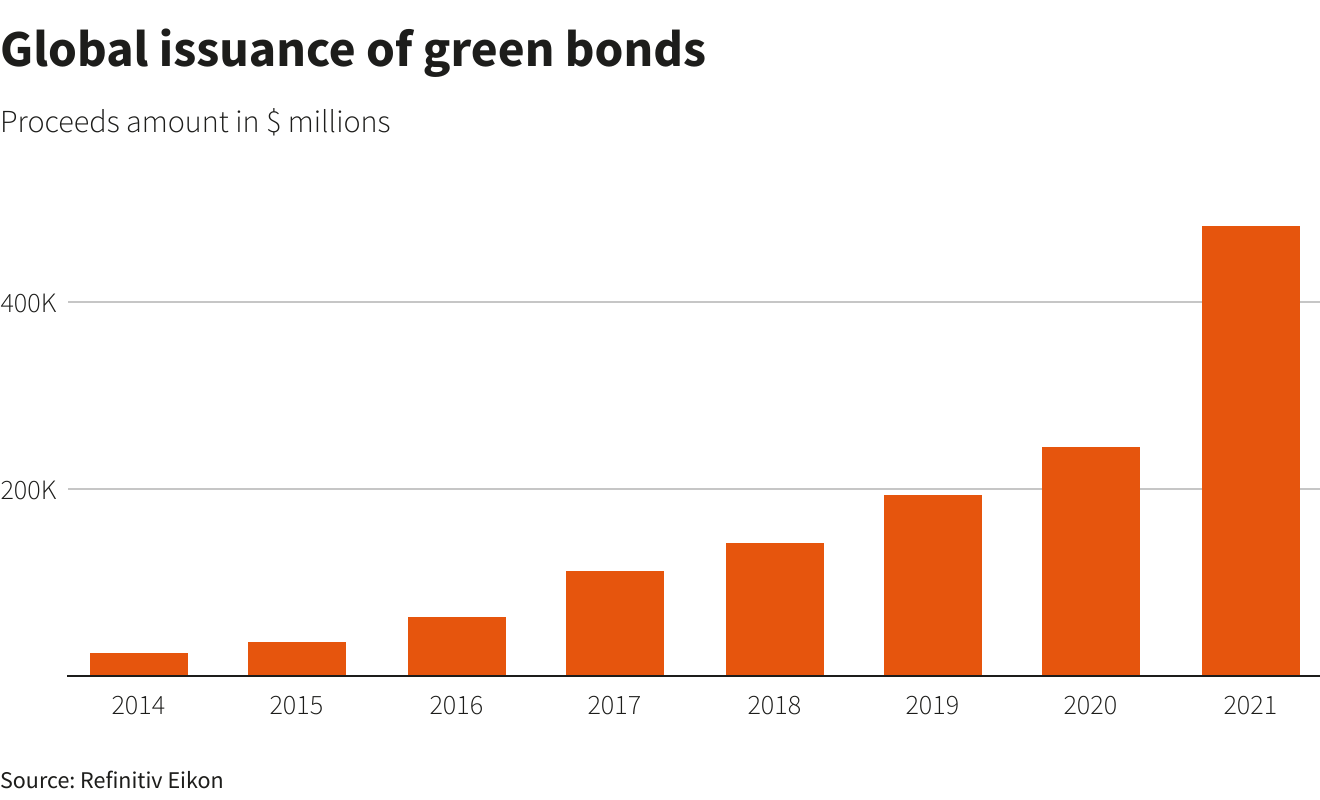
Today, environmental criteria are very important for investors. Green bonds are often seen as a perfect solution to mix profit and sustainability. In fact, according to the Climate Bonds Initiative, the global green bond market surpassed $550 billion in annual issuance in 2021, showing a growing demand. However, are green bonds really different from traditional bonds, or are they just a marketing strategy from companies to appear more ethical?

This article looks at the definition of green bonds and their limits to see if they are a real financial innovation or just some greenwashing used to make even more money.

What is a Green Bond?

First, a green bond is a debt instrument, so the money raised must be used only for projects that help the environment.

Technically, green bonds work exactly like normal bonds. They have a maturity date, they pay interests (coupons). For instance, if a company issues a green bond to build a solar farm and goes bankrupt, the investor loses money, just like with a standard bond.

The only real difference is that the money must finance green projects. There are voluntary rules, like the Green Bond Principles by the ICMA (International Capital Market Association), for transparency, but they are not laws.

Global annual green bond issuance (USD bn).
Global annual green bond issuance chart
Source: Reuters

A Fast-Growing Market

Since the first green bond by the European Investment Bank in 2007, the market has grown a lot. Now, it is a big part of the bond market. There are three main reasons for this evolution:

  • Demand: Investors want to respect ESG (Environmental, Social, and Governance) rules and are more eco-conscious.
  • Regulations: Governments encourage green finance and incentivize people to invest in those funds by creating advantages.
  • Reputation: For companies, issuing a green bond is good for their image. It shows they care about the planet and the future.

Are They Financially Different?

From a financial point of view, green bonds are very similar to classic bonds. The risk and the return are usually equivalent.

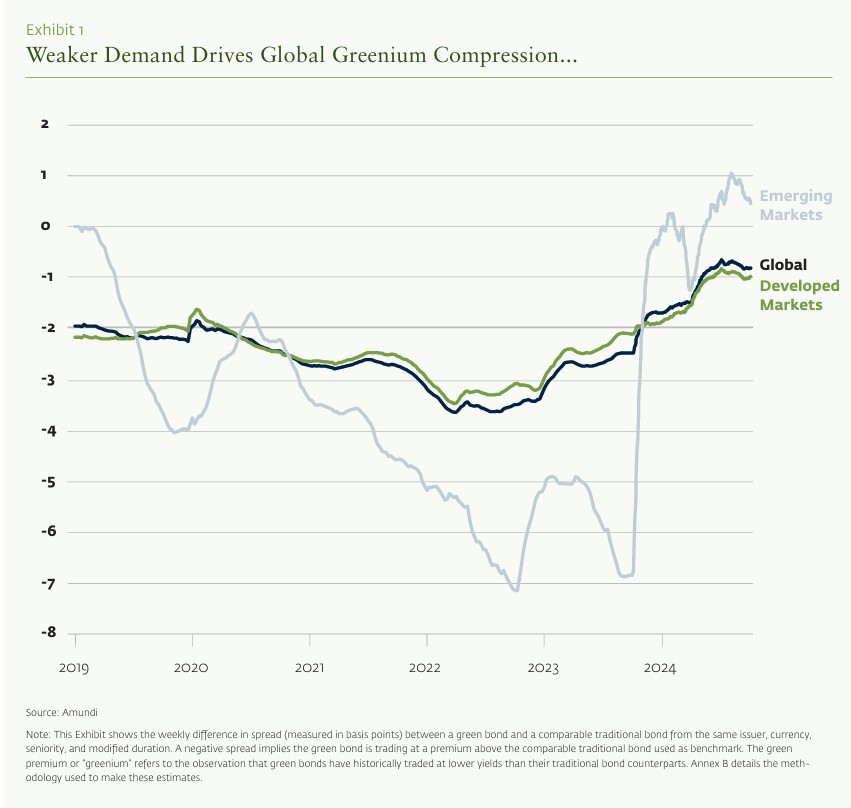
There is a debate about a “greenium” or green premium. This means that investors might accept a lower interest rate because the bond is green. But in reality, the price of the bond depends mostly on interest rates and the credit quality of the issuer, not just the “green label”.

Evolution of the “Greenium” (yield difference between green and non-green bonds).
Greenium evolution chart
Source: Amundi

The Risk of Greenwashing

The main problem with green bonds is transparency. The definition of a “green project” can be vague.

This creates a big risk of “greenwashing.” A company might label a bond as green for a project that is not very ambitious, just to attract investors. The OECD has also warned that greenwashing can undermine trust in sustainable finance markets if issuers exaggerate environmental benefits.

Even if there are auditors to look into the projects, there are still not enough binding rules and laws to compare and verify whether a project is truly green. The International Capital Market Association (ICMA) notes that its Green Bond Principles remain voluntary guidelines rather than legal regulation.

Why do Investors Buy Them?

For investors, green bonds are very useful. They allow them to respect their sustainability goals without changing the risk of their portfolio. In particular, they are widely purchased by institutional investors such as pension funds, insurance companies, and asset managers, who increasingly integrate ESG criteria into their investment strategies.

However, buying a green bond does not always mean better returns or better diversification. It is often a decision based on strategy and regulation, not just financial performance.

The Spectrum of Capital: positioning green bonds between traditional investment and impact investing.
The Spectrum of Capital
Source: Russell Investments

Conclusion

From a technical standpoint, green bonds do not represent a new financial mechanism. They function exactly like traditional bonds.

However, from a strategic perspective, they are a real innovation. They shift how capital is allocated by directing funds specifically toward environmental goals, forcing issuers to be more transparent.

While they are not a perfect solution for climate change and carry risks of greenwashing, green bonds remain a vital tool. They bridge the gap between financial markets and the urgent needs of our planet.

Related posts on the SimTrade blog

   ▶ Anant JAIN Social Impact Bonds

   ▶ Louis DETALLE What are green bonds?

   ▶ Anant JAIN Environmental, Social & Governance (ESG) Criteria

   ▶ Nithisha CHALLA US Treasury Bonds

Useful resources

OECD Protecting and empowering consumers in the green transition

ESG News US Green Bond Sales Near Record High, Reaching $550B: BloombergNEF Repor

Banque de France (April 2025) Obligation verte

Climate Bonds Initiative Market Data

ICMA Green Bond Principles

Amundi Research Center ESG & Green Bonds

About the author

The article was written in February 2026 by Mathis HOUROU (ESSEC Business School, Global Bachelor in Business Administration (GBBA)).

   ▶ Discover all articles by Mathis HOUROU.
My Internship Experience at Société Générale Private Banking

Mathis HOUROU

In this article, Mathis HOUROU (ESSEC Business School, Global Bachelor in Business Administration (GBBA)) shares his professional experience as an intern in Société Générale Private Banking, showing the role of analytical tools, performance monitoring and advisory support in a wealth management environment.

About the company

Société Générale is a major European banking group with operations in more than 60 countries. As of 31 December 2024, the Group employed approximately 119,000 people, served over 26 million clients in 62 countries, and reported total assets of EUR 1,573.5bn with total equity of EUR 79.6bn. In 2024, net banking income amounted to EUR 26.8bn, while group net income reached EUR 4.2bn.

Logo of Société Générale Private Banking.
Logo of Société Générale Private Banking
Source: Société Generale.

Société Générale is one of the largest European banking groups, offering retail banking, corporate and investment banking, and wealth management services. The Group operates in multiple countries, from individuals to large companies, with diversified financial activities.

Within the Group, private banking represents a very strategic business dedicated to high-net-worth individuals (HNWI). It combines investment advisory, portfolio management, and long-term wealth structuring, relying mainly on a close relationship with the clients.

The role of this segment is crucial for the bank, as high-net-worth individuals (HNWI) create a lot of value. If the bank can’t offer them a service that is differentiating from normal clients, they will go to the competitor. The clients are either coming from the retail segment named SGRF when their account is reaching a certain amount (often around 500k€) or acquired directly from the competitor. In order to do so, Société Générale Private Banking (SGPB) is offering a panel of different investments, exclusive offers, special relationships, and many more.

My internship

During my internship, I worked within the “Maison de Gestion et Conseil” team at Société Générale Private Banking in Paris. My team was responsible for the entire segment of “Banque Privée” and “Gestion Privée” in France, acting as a support function for private bankers and management.

Over a period of 6 months, my role consisted in assisting the team with the day-to-day operation. Being able to help senior managers with precision, professionalism, and efficiency with almost no prior experience was really challenging.

My missions

My main task focused on the development and improvement of analytical and reporting tools, mainly via Excel and PowerPoint, used by private bankers and management teams. These missions aimed at facilitating the monitoring of portfolio performance and the interpretation of market trends.

More specifically, my responsibilities included the design of presentations and analytical materials to close every trimester. Those presentations were crucial for the bank, and I had to make them fast with no error margin. I repeated the operation for every manager with their own suggestions and special demands.

Concretely, I had to take the results from internal tools, bring them into multiple Excel files, rework the data, and make multiple indicators and graphs highlighting the results of each banker and compare them to one another. Then, I needed to repeat the operation for every manager and compute all the graphs in one presentation.

Required skills and knowledge

This internship required a solid understanding of the banking industry; analytical skills were necessary to interpret financial data and translate it into meaningful indicators. In addition, great use of Excel and presentation tools was essential to build clear and structured reporting materials.

Now for the soft skills, the role required rigor, adaptability and the ability to communicate effectively with professionals having different levels of technical expertise. For the most part they had a very deep knowledge of the business but were a bit less skilled in Excel and the different tools used for monitoring. The synergy was great since they made me learn about Private banking and management, and I helped them with the technical part.

What I learned

This internship provided valuable insights into how private banking operates on a daily basis. I learned how performance is monitored, how market and geopolitical information is used for decisions, and how analytical tools support client-oriented strategies.

Financial concepts related to my internship

I present below three financial concepts related to my internship: Assets Under Management (AUM), Portfolio Performance Measurement and Currency Risk, and Interest Rate Spreads and Bank Profitability.

Assets Under Management (AUM)

Assets Under Management (AUM) is a key indicator in private banking, it is the total value of client assets managed by a banker or a region for example. During my internship, AUM was very important in reporting tools, it helps me measure business size and prepare future budget and objectives. It is also useful for comparisons between regions of different sizes by adjusting performance indicators to the amount of assets managed, which was essential in the dashboards and presentations I worked on.

Portfolio Performance Measurement and Currency Risk

Another important concept is portfolio performance measurement, which is essential to monitor investment results and support advisory decisions. Through my reporting work, I learned that performance depends not only on asset returns but also on external factors such as currency risk. For example, in 2025, strong returns from US equities like the S&P 500 has been reduced for European investors because of to the depreciation of the US dollar against the euro. This shows the importance of integrating FX effects for performance analysis.

Interest Rate Spreads and Bank Profitability

Interest rate spreads are crucial for the bank profitability; it is the difference between borrowing and lending rates. Changes in monetary policy and market rates have a huge impact on the bank’s net interest revenue. In private banking, the interest rate environment influences client allocations, which is why these macro indicators were often included in the monitoring presentations I prepared.

Why should I be interested in this post?

For finance students, I would say that private banking offers a unique perspective on financial markets, portfolio management and client advisory.

This type of internship is particularly relevant for students interested in careers in asset management, wealth management, advisory roles, or bankers. It opens a lot of doors and allows you to meet the top of the managing chain in a competitive environment.

Related posts on the SimTrade blog

   ▶ All Professional Experiences

   ▶ Bryan BOISLEVE My internship experience as a Counterparty Risk Analyst at Société Générale

   ▶ Hélène VAGUET-AUBERT Private banking: evolving in a challenging environment

   ▶ Alberto BORGIA My Experience as a Wealth Management Intern at Nextam Partners – SimTrade blog

   ▶ Samia DARMELLAH My Experience as a Credit Risk Portfolio Analyst at Société Générale Private Banking

Useful resources

Société Générale Private Banking Découvrez la Banque Privée Société Générale

Société Générale Q4 2024 Financial Results restated quarterly series

About the author

The article was written in February 2026 by Mathis HOUROU (ESSEC Business School, Global Bachelor in Business Administration (GBBA)).

   ▶ Discover all articles by Mathis HOUROU.